

The future of VPNs: Are they being replaced by SASE and ZTNA?
The future of VPNs: Are they being replaced by SASE and ZTNA?

Virtual private networks (VPNs) have been the go-to solution for years to ensure secure connections to corporate networks. However, with the rise of remote work, the adoption of multi-cloud environments, and the increase in cyber threats, companies are rethinking their access security strategies. In this context, two new technologies are gaining popularity: SASE (Secure Access Service Edge) and ZTNA (Zero Trust Network Access).
At ESED, we felt it necessary to analyze the current role of VPNs, their limitations, and how SASE and ZTNA are emerging as more secure and efficient alternatives for businesses.
As cybersecurity specialists, we are closely monitoring these options to see how they continue to advance and develop.
About Traditional VPNs
While VPNs have been an effective solution for connecting remote employees and satellite offices to corporate networks, they are now beginning to show some limitations, especially with the rise of cyber threats and the emergence of new technologies like Artificial Intelligence:
Limited Security
Traditional VPNs work by allowing access to the entire internal network, which means that if a user’s credentials are compromised, cybercriminals can move laterally within the corporate infrastructure. This represents a significant risk in a world where insider threats and cyberattacks are becoming increasingly sophisticated.
Slowness
VPNs can be slow and affect employee productivity, as they often introduce latency due to the need to route traffic through centralized servers. Furthermore, they require manual configurations that can be complicated for end users.
Limited Scalability
VPNs were not designed for cloud-based environments. With the growth of remote work and the adoption of SaaS applications, businesses need secure access solutions that can scale efficiently without relying on traditional network infrastructure.
Management and Maintenance
Managing a VPN infrastructure can be complex, especially for companies with globally dispersed employees. Configuration, monitoring, and enforcement of security policies require a significant investment of time and resources.
SASE and ZTNA: The Natural Evolution of Access Security
Faced with these limitations, organizations are adopting more modern approaches, such as SASE and ZTNA, which offer greater security, flexibility, and efficiency in remote access management.
ZTNA (Zero Trust Network Access): Security Based on Zero Trust
The Zero Trust Network Access concept is based on the principle of «never trust, always verify.» Instead of granting full network access, as VPNs do, ZTNA grants limited, context-based access to the specific resources each user needs.
Key advantages of ZTNA:
– Segmented access: Users can only access the applications and data they require, minimizing the risk of lateral movement in the event of a security breach.
– Continuous authentication: The user’s identity and context are constantly verified, ensuring secure access.
– Enhanced protection against internal and external threats: Reduces system exposure by limiting network visibility.
SASE (Secure Access Service Edge): A comprehensive cloud solution
SASE is a security framework defined by Gartner that combines ZTNA, SD-WAN, next-generation firewalls (FWaaS), Secure Web Gateway (SWG), and Cloud Access Security Broker (CASB) in a cloud-based model. Its goal is to provide a secure and optimized access solution for remote employees, branch offices, and cloud resources.
Key advantages of SASE:
– Unified security: Integrates multiple security solutions into a single managed cloud service.
– Performance optimization: Reduces latency by intelligently routing traffic through the most efficient network.
– Global scalability: Easily adapts to businesses with distributed access needs without requiring physical hardware.
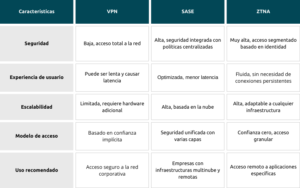
Differences between VPN, SASE, and ZTNA
To better understand which is the best option for each organization, it is important to analyze the differences between these three approaches:
Which is the best option for your company?
The choice between VPN, SASE, and ZTNA depends on the specific needs of each organization:
– VPN: Ideal for companies with a traditional IT infrastructure that require a quick and easy solution to connect remote employees.
– ZTNA: Recommended for organizations looking to improve security and minimize the risk of unauthorized access, especially in remote and distributed environments.
– SASE: The best option for companies seeking a scalable, efficient, and cloud-based security solution to protect hybrid networks and remote access.
Will SASE and ZTNA completely replace VPNs?
Technology is constantly evolving, causing some technologies to be replaced by others with an improved version to adapt to current market needs. However, for now, VPNs are expected to continue being used for specific cases, such as secure connections in corporate networks. However, there is a growing trend towards choosing SASE and ZTNA as secure connection methods in businesses.
How to move from VPNA to SASE or ZTNA
For organizations looking to modernize their access security approach, the transition from VPN to ZTNA or SASE should be planned gradually:
– Risk and needs assessment: Identify weaknesses in the current VPN infrastructure.
– Implement ZTNA for critical access: Prioritize sensitive applications and remote users.
– Gradual migration to SASE: Integrate cloud services to improve security and optimize performance.
– Continuous monitoring and adjustment: Review access policies to adapt to the evolving needs of the business.
While VPNs will continue to exist in some environments, companies seeking to improve their security, scalability, and user experience are adopting models based on ZTNA and SASE.
Investing in these technologies not only reduces the risk of cyberattacks but also optimizes remote access and cloud network management. In a world where security and agility are key to business continuity, moving to solutions like ZTNA and SASE is an essential strategic decision for modern businesses.
Source: www.esedsl.com