
How Federated Learning Is Changing Enterprise Data Management
How federated learning reshapes enterprise data architectures
Enterprise data management has long depended on centralized repositories that aggregate information from multiple systems. While this model supports large-scale analytics, it also creates security, compliance, and scalability challenges. Federated learning introduces a different approach by enabling machine learning models to be trained directly where enterprise data is generated and stored.
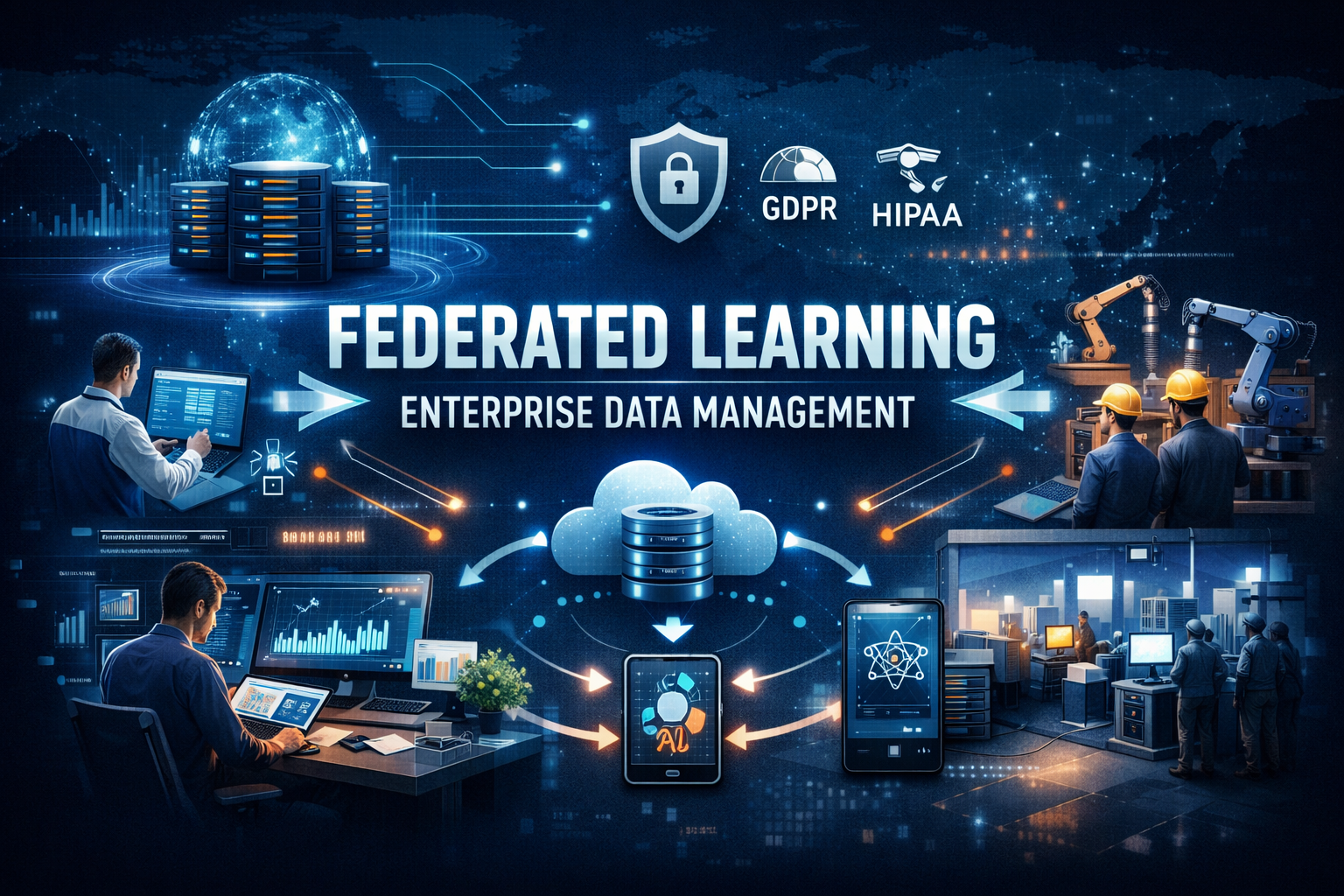
In complex organizations, data is naturally distributed across regions, business units, and infrastructures. Federated learning enterprise strategies align with this reality by deploying models to local environments and aggregating only model updates. This reduces the need to move sensitive data and lowers the risk associated with central data concentration.
Privacy and compliance as strategic drivers
Regulatory pressure has become a defining factor in enterprise data management. Data protection laws increasingly restrict how personal and sensitive information can be transferred or centralized. Traditional architectures often struggle to adapt to these requirements without sacrificing analytical capabilities.
Federated learning supports privacy-first architectures by keeping raw data within its original environment. Only encrypted parameters are shared during training. This significantly reduces exposure to data breaches and simplifies compliance with data residency and governance rules, especially in regulated industries.
Reducing data silos without sharing raw data
Data silos remain a major obstacle in large enterprises. Legal, operational, or competitive constraints often prevent direct data sharing between teams or subsidiaries. Federated learning enables collaboration without transferring ownership of data.
Each participant contributes to a shared model while maintaining full control over its datasets. This allows enterprises to extract broader insights from distributed data sources without violating confidentiality or internal policies. As a result, federated learning enterprise implementations redefine how organizations collaborate around data.
Operational impact on enterprise AI systems
Adopting federated learning changes operational priorities. Enterprises must focus on orchestration, model versioning, and secure aggregation instead of large-scale data ingestion. Monitoring performance across distributed nodes becomes essential to maintain consistency and reliability.
Although this approach introduces additional complexity, it also improves resilience. Distributed training reduces dependency on centralized infrastructure and minimizes single points of failure. Over time, enterprises gain more scalable and adaptable AI systems aligned with their data realities.
Strategic limitations and future outlook
Federated learning is not suitable for every scenario. Distributed training can increase latency and coordination costs. Data heterogeneity across environments may also affect model performance if not carefully managed.
In the long term, federated learning is expected to coexist with centralized data management models. Hybrid strategies will allow enterprises to apply federated learning where privacy, compliance, or data sovereignty are critical, while retaining centralized approaches for other use cases. Enterprises that adopt this balance early will be better positioned to scale AI responsibly.
Source: McKinsey & Company