
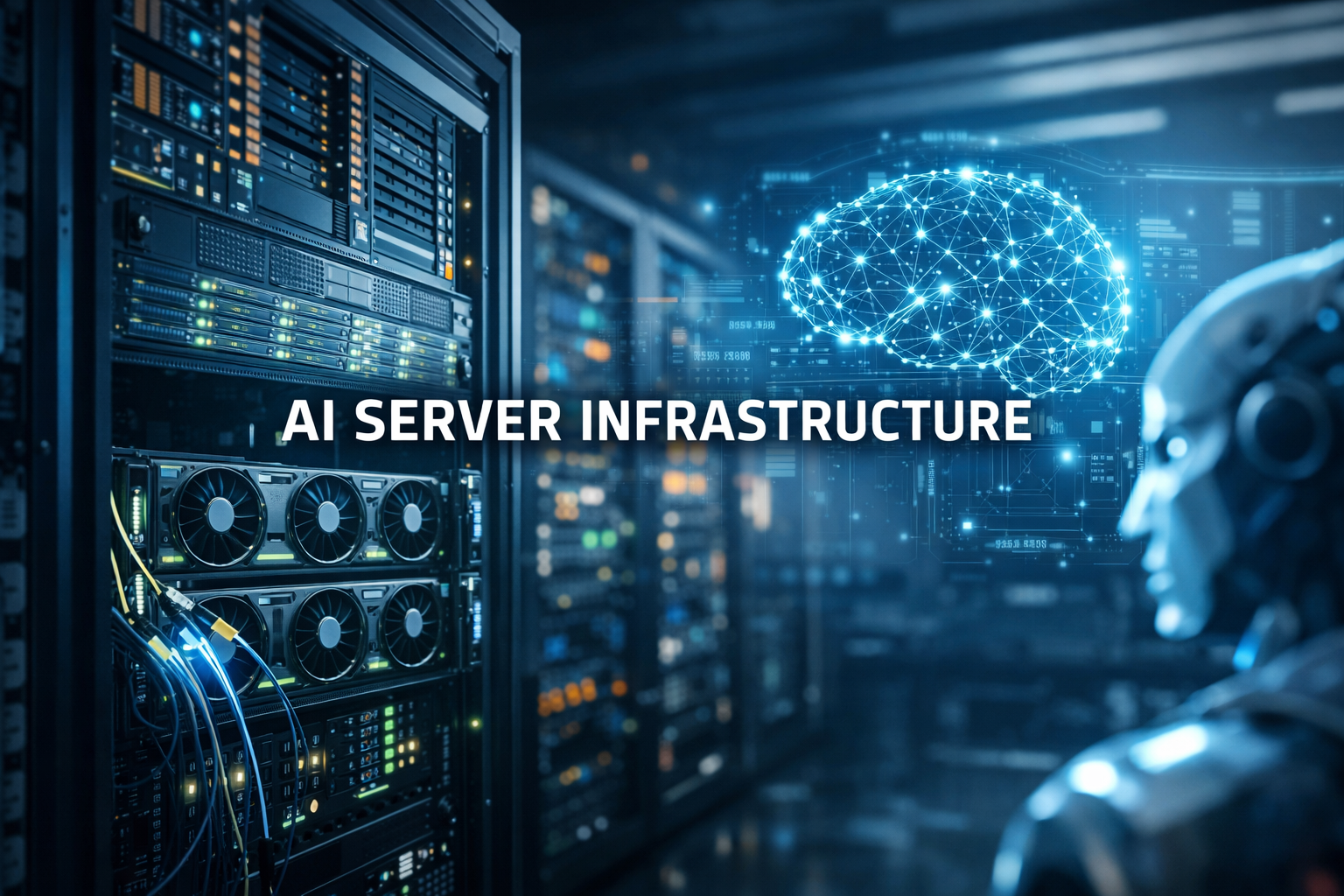
How AI server infrastructure is reshaping modern data centers
Infrastructure demands driven by artificial intelligence
AI server infrastructure has become a critical component for enterprises integrating artificial intelligence into their operations. Traditional server environments struggle to meet the computational intensity required by machine learning and deep learning models. AI workloads rely on massive parallel processing, fast memory access, and sustained performance over long execution cycles. This shift is driving a redesign of data center architectures, focusing on performance density and workload efficiency.
Organizations deploying AI at scale must consider power consumption, thermal limits, and system reliability. AI applications often run continuously, placing sustained stress on hardware. As a result, infrastructure planning now prioritizes resilience, scalability, and optimized resource utilization rather than general-purpose flexibility.
GPU acceleration and specialized server architectures
The evolution of AI server infrastructure is closely tied to the adoption of GPU-accelerated servers. GPUs outperform CPUs in parallel computation, making them essential for training and inference tasks. Modern AI servers integrate multiple accelerators within a single node, supported by high-bandwidth memory and optimized interconnects.
These specialized architectures reduce processing bottlenecks and improve overall throughput. As AI models grow in size and complexity, server platforms must support rapid data movement between compute, memory, and storage layers. This has increased demand for purpose-built AI servers designed for high-performance and consistency under heavy workloads.
Networking and scalability considerations
Scalable AI server infrastructure depends heavily on advanced networking. Distributed AI workloads require low-latency, high-throughput connections between servers to maintain performance during multi-node training processes. Efficient networking ensures that compute resources remain synchronized and prevents data transfer delays from limiting scalability.
Modular infrastructure design allows organizations to expand AI capacity incrementally. This approach reduces upfront investment risk while ensuring that infrastructure can grow alongside evolving AI initiatives. Scalability is no longer optional; it is a foundational requirement for sustainable AI deployment.
Long-term planning for AI-focused data centers
Building AI server infrastructure is a long-term strategic decision. Hardware lifecycles, energy efficiency, and cooling capabilities must align with future AI development. Data centers that invest in adaptable server environments are better positioned to adopt new AI frameworks and hardware innovations.
As artificial intelligence becomes embedded across enterprise systems, AI server infrastructure will remain central to performance, innovation, and competitive advantage.
Source: Gartner