

Microsoft says goodbye to SQL Server Web in version 2025
Microsoft says goodbye to SQL Server Web in version 2025: what changes for hosts and SMEs
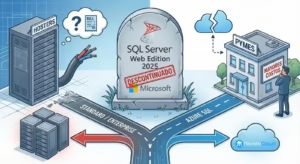
Microsoft has officially confirmed that SQL Server 2025 will not have a Web Edition. The company will continue to offer the Enterprise, Standard, Express, and Developer editions, but SQL Server 2022 will be the last version with a Web Edition, which will maintain support until January 2033 according to Microsoft’s fixed lifecycle policy.
Behind this move is a clear change in strategy: a greater focus on security and AI capabilities within SQL Server, and a more prominent role for Azure SQL as the natural choice for modern web applications and multi-tenant environments.
SQL Server 2022 Web, the last stop until 2033
The SQL Server Web Edition was introduced in 2008 to fill a very specific niche:
small and medium-sized web applications, with an absolute focus on cost and typically deployed through hosts and providers with SPLA licenses.
-With SQL Server 2025, that option disappears:
-There will be no SQL Server 2025 Web Edition.
-SQL Server 2022 Web will be the last available version, with security support and updates until January 2033, in accordance with Microsoft’s fixed lifecycle.
-Microsoft encourages customers to explore alternatives such as SQL Server 2025 Standard or Azure SQL Database.
In practice, the coming years will be a transition period: projects that currently rely on Web Edition will have some leeway, but also a clear date by which they will need to migrate.
A database designed for AI needs built-in security.
Microsoft frames this change within a very specific context: SQL Server 2025 arrives with a strong focus on AI-driven capabilities. With models and assistants increasingly integrated into the platform, the company emphasizes that security is no longer an extra but a critical requirement.
Some of the features that Microsoft already considers essential for protecting sensitive data in AI scenarios include:
-Transparent Data Encryption (TDE) to encrypt data at rest.
– Extensible Key Management (EKM) for more advanced and integrated encryption key management.
These features are not available in the Web edition, but rather in Standard and higher editions, along with scalability and performance improvements designed for modern workloads and AI scenarios. In other words, if the database is going to coexist with AI functionalities within the engine itself, Microsoft wants it to do so with a minimum of enterprise-level security guarantees.
From Web edition to Azure SQL: the new path for web applications
Historically, SQL Server Web edition has been the «logical» choice for many small and medium-sized web applications, especially in shared hosting environments or low-cost dedicated servers.
Today, Microsoft believes that Azure SQL Database occupies that space, offering:
– Elastic scalability adapted to peak loads and multi-tenant environments.
– Pay-as-you-go models and elastic pools to host many databases for different customers.
-Direct integration with the rest of Azure services, including AI, analytics, and observability tools.
The message is clear:
For new web applications or projects that can move to the cloud, Microsoft wants the natural alternative to Web Edition to be not another edition of SQL «installed on a server,» but Azure SQL as a managed service.
Source: www.revistacloud.com