
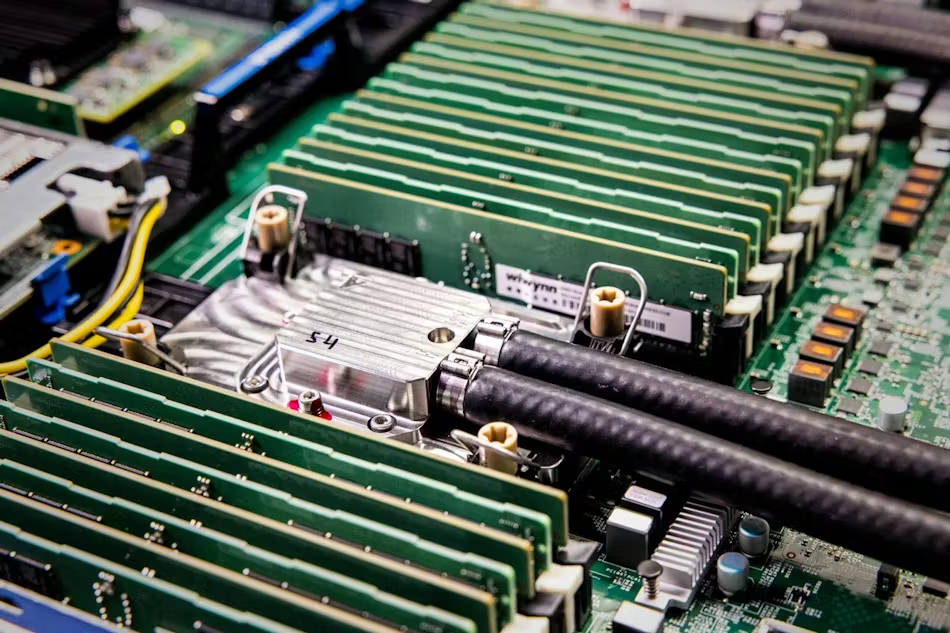
Microsoft’s microfluidic-on-a-chip technology
Microsoft’s In-Chip Microfluidics Technology Resets the Limits of AI Cooling
Microsoft has unveiled an in-chip microfluidic cooling system that channels coolant through microscopic pathways etched into the silicon itself—delivering up to three times greater heat removal than conventional cold plates and paving the way for denser, more efficient AI hardware with lower operating costs.
Key Highlights
- Microsoft’s in-chip microfluidics channels coolant directly beneath or beside hotspots, drastically reducing thermal resistance compared to traditional cold plates.
- The technology can improve cooling performance by up to three times, lowering peak temperatures by as much as 65%, and enabling higher power densities in AI hardware.
- AI-driven, biomimetic microchannel design optimizes coolant flow, enhancing thermal efficiency and workload-specific heat management.
- Microfluidics could support higher TDP GPUs, denser server configurations, and advanced 3D-stacked architectures, unlocking new performance levels.
- Challenges remain in manufacturing scalability, ecosystem standardization, and reliability, which are critical for widespread adoption and deployment.
In September 2025, Microsoft unveiled a chip-level liquid-cooling technology that channels coolant through microscopic passages etched directly into the silicon die—or into the backside of the chip package—rather than across an external cold plate. The company reports that this “in-chip microfluidics” approach can remove heat up to three times more effectively than current state-of-the-art cold-plate systems, reducing peak chip temperature rise by as much as 65 percent in prototype testing under specific workloads and configurations.
Microsoft also highlighted its use of AI-driven design tools to “shape” the microchannel networks—biomimetic, leaf-vein-inspired patterns that direct coolant precisely to on-die hotspots associated with different workloads. The company credited a collaboration with Swiss startup Corintis for key aspects of the design and validation process.
In its supporting materials, Microsoft framed microfluidics as part of a broader systems-level strategy—“from chips to servers to the datacenter”—aimed at overcoming the thermal and power limits constraining today’s increasingly dense AI accelerators and emerging 3D-stacked architectures. An accompanying infographic underscored the up-to-3× cooling performance (with configuration caveats) and projected lower water and power requirements for data-center-scale cooling systems.
How Microfluidics Differs from Today’s Liquid Cooling
To appreciate Microsoft’s in-chip cooling breakthrough, it helps to compare where and how heat is captured in current data center designs versus microfluidic systems.
- Cold plates (status quo): A machined plate sits atop a heat spreader, drawing heat away through multiple thermal interfaces before coolant carries it to an external loop.
- Immersion: The entire board or subsystem is submerged in a dielectric fluid, which transfers heat into a coolant distribution unit (CDU) loop for rejection.
- Microfluidics: Coolant flows through micron-scale channels etched directly beneath or adjacent to chip hotspots, shrinking the thermal resistance path and capturing heat at its source rather than over the lid. Microsoft’s innovation lies in AI-optimized, bio-inspired channel networks that are co-tuned to each chip’s silicon layout and workload heat map.
Microsoft reports that in-chip microfluidics can deliver up to three times better heat removal than leading cold-plate designs. Independent technical analyses of Microsoft’s prototype testing note a roughly two-thirds reduction in peak temperature rise, depending on workload and configuration.
Cooling performance gains of that magnitude could either increase thermal headroom, enabling higher clock or power settings, or maintain current performance with lower coolant flow and warmer loop temperatures, improving efficiency. In practice, this flexibility could allow operators to better match workload profiles to site conditions and optimize thermal performance across regions.